Insane alternative assets
For those who dare, the hunt for uncorrelated returns is eternal. However, returns for traditional asset types tend to be more correlated (and less cool) than we'd like to believe. Hence, I've laid out some crazy asset types you can invest in. That is, if you're brave enough.
For those who dare, the hunt for uncorrelated returns is eternal. However, returns for traditional asset types tend to be more correlated (and less cool) than we'd like to believe. Hence, I've laid out some crazy asset types you can invest in. That is, if you're brave enough.
Correlation can be defined as:
a measure of the strength and direction of the linear relationship between two variables, indicating how much they tend to change together.
In investing, it is common practice to try and diversify your portfolio between assets that have uncorrelated returns, meaning that if one asset has poor performance, your other assets are less likely to also perform badly.
Though there are exceptions, traditional asset types like equities, fixed-income securities, cash, currencies, commodities, and real estate can have significantly correlated returns. For example, according to the asset class correlation map from Guggenheim Investments over 2024 Global equities and REITs are highly correlated. To a lesser extent, we also see moderate correlation between global equities and both commodities and currencies. Therefore, diversification between these asset classes is of limited use, if you are focusing on uncorrelated returns.
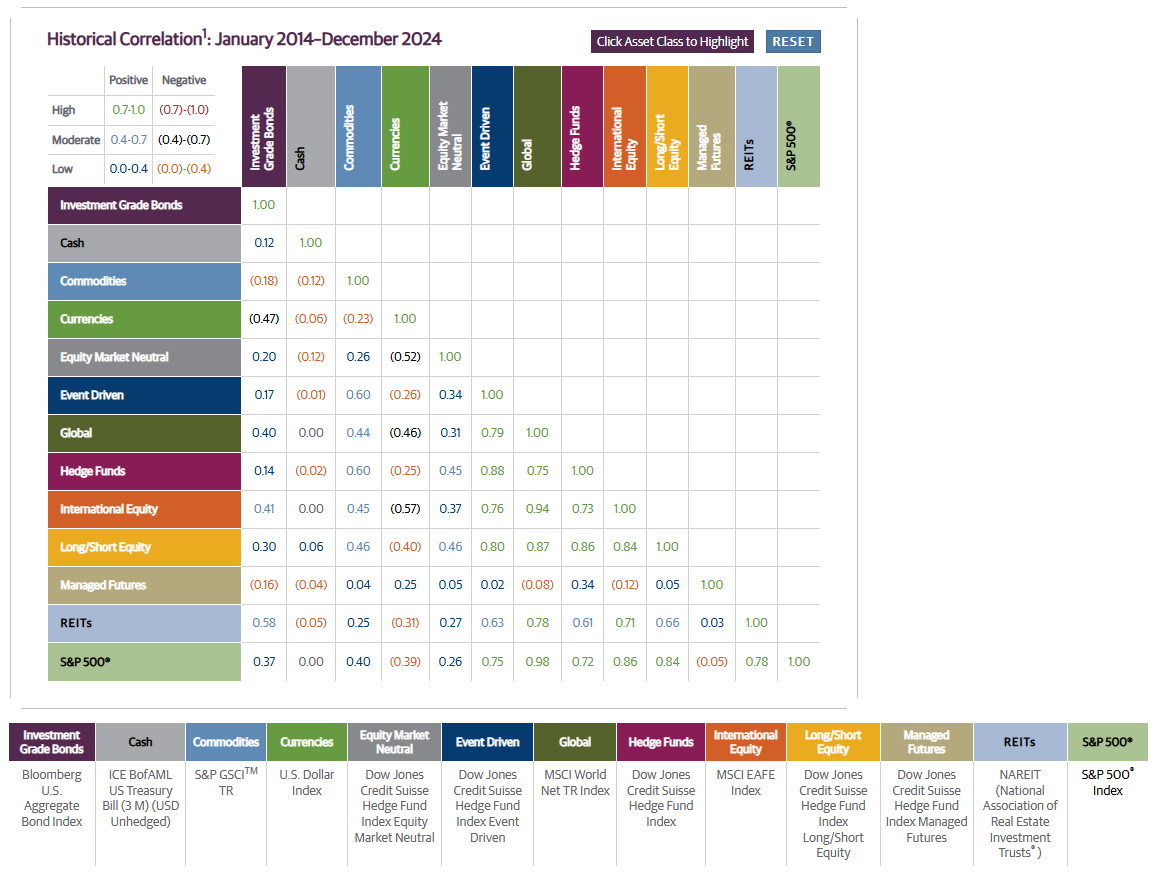
Of course, looking at the chart, there are also examples with low correlation, which is important to keep in mind. And while you can- and probably should- build a portfolio of these traditional asset classes, we can also have a little more fun by diving into the bizarre.
Litigation financing
What: going to court costs money, winning cases brings in money. Litigation financing focuses on making money by providing financing to plaintiffs, and in return getting a portion of recovered funds from them if they win. I've drawn out a basic explanation below.
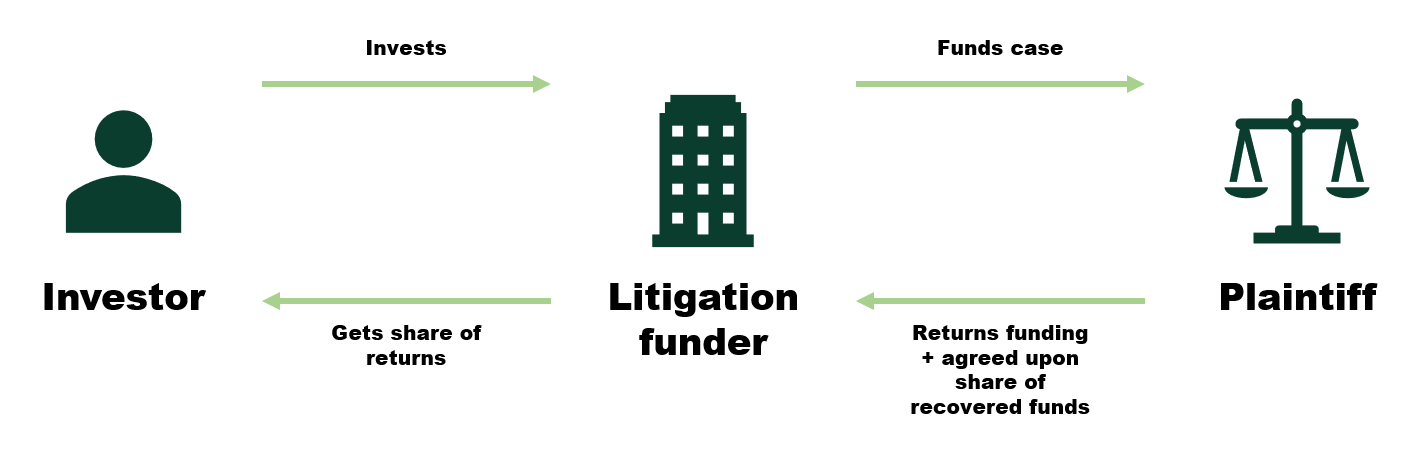
There are several ways to invest, mainly equity and debt. Furthermore, there are often different investment vehicles for different case types (Mass Tort, Personal Injury, Commercial Claims, etc.).
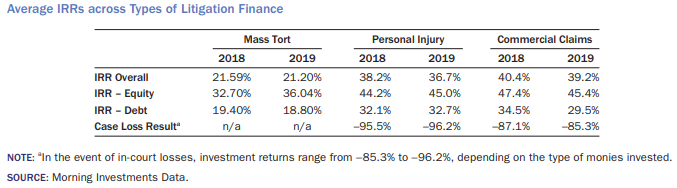
Performance: while returns in litigation finance can be opaque, a study by Healey, McDonald, and Haley (2022) found average returns in excess of 20% annually in a 2018-2019 sample of 214 transactions. Some of their key results are listed below.
How to invest: you can invest through litigation funders. Though it is important to note that these parties often only let accredited investors invest directly. Retail investors can get exposure through investing in publicly traded litigation funders.
Key players include: Burford Capital (Listed on NYSE and LSE, ticker BUR), Omni Bridgeway (Listed on ASX, ticker OBL), LexShares (Private/restricted).
Luxury items
What: invest in what you know. Collectors and traders have been making a killing for ages in markets for all sorts of items. Think staple items like watches, handbags, fine art, coins etc.
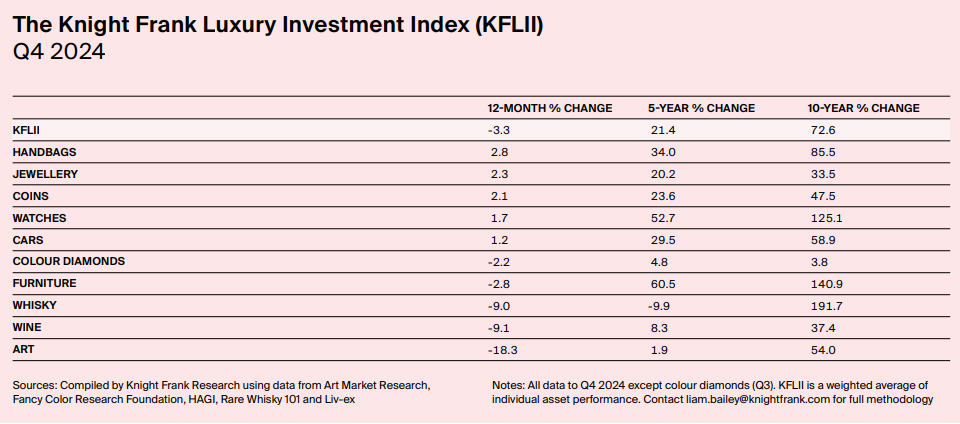
Performance: see the overview below, from the 2025 Knight Frank Wealth report 2025.
How to invest: there are two ways to invest.
- Buy items directly (duh).
- Buy an investment vehicle, to invest in a class of items.
The future is strange
Okay, i know I am cheating a bit here by including some commodity futures, but some are too temptingly esoteric to not mention here.
What:
- Unusual agricultural products: forget the usual suspects like coffee or cocoa—there’s a whole carnival of weird commodities out there with active futures markets.
- Frozen orange juice (FCOJ) futures: A highly volatile market, where hurricanes or crop diseases can trigger significant supply disruptions and price spikes.
- Non-fat dry milk futures: Traded on the CME, these contracts help participants hedge against fluctuations in the price of this dairy product.
- Oats: A widely traded soft commodity, with prices strongly influenced by weather conditions that affect crop yields.
- Weather-related futures: so the weathermen CAN make it rain.
- Snowfall and rainfall futures: Traded on the CME, they help industries such as freight operators or utility providers protect themselves against excessive or insufficient precipitation.
- Hurricane futures: Linked to the CME Hurricane Index, these contracts enable parties exposed to hurricane damage to reduce their risk.
How to invest: most brokers facilitate investing in futures.
At the end of the day, uncorrelated returns live in strange places—and sometimes the stranger, the better. Sure, these bets aren’t for the faint of heart, but if you’re willing to step outside the vanilla, you just might find opportunities hiding in the bizarre.
Sources:
- Guggenheim Investments. (n.d.). Asset class correlation map. In Advisor resources: Interactive tools. Retrieved September 14, 2025, from https://www.guggenheiminvestments.com/advisor-resources/interactive-tools/asset-class-correlation-map
- Healey, T., McDonald, M. B., & Haley, T. S. (2022). Litigation finance investing: Alternative investment returns in the presence of information asymmetry. The Journal of Alternative Investments, 24(4), 110–122. https://doi.org/10.3905/jai.2022.1.149
- Knight Frank. (2025). The wealth report 2025: The global perspective on prime property and investment (19th ed.). Knight Frank LLP. https://www.knightfrank.com/research